
Posted on: January 26, 2026
Can digital innovation increase the return on investment (ROI) of community health? New evidence from Kenya suggests it can, when designed for government systems and scale.
Our latest study from Teso North, Kenya, shows that embedding telemedicine within government community health frameworks significantly improves clinical decision-making and maternal and child health outcomes.
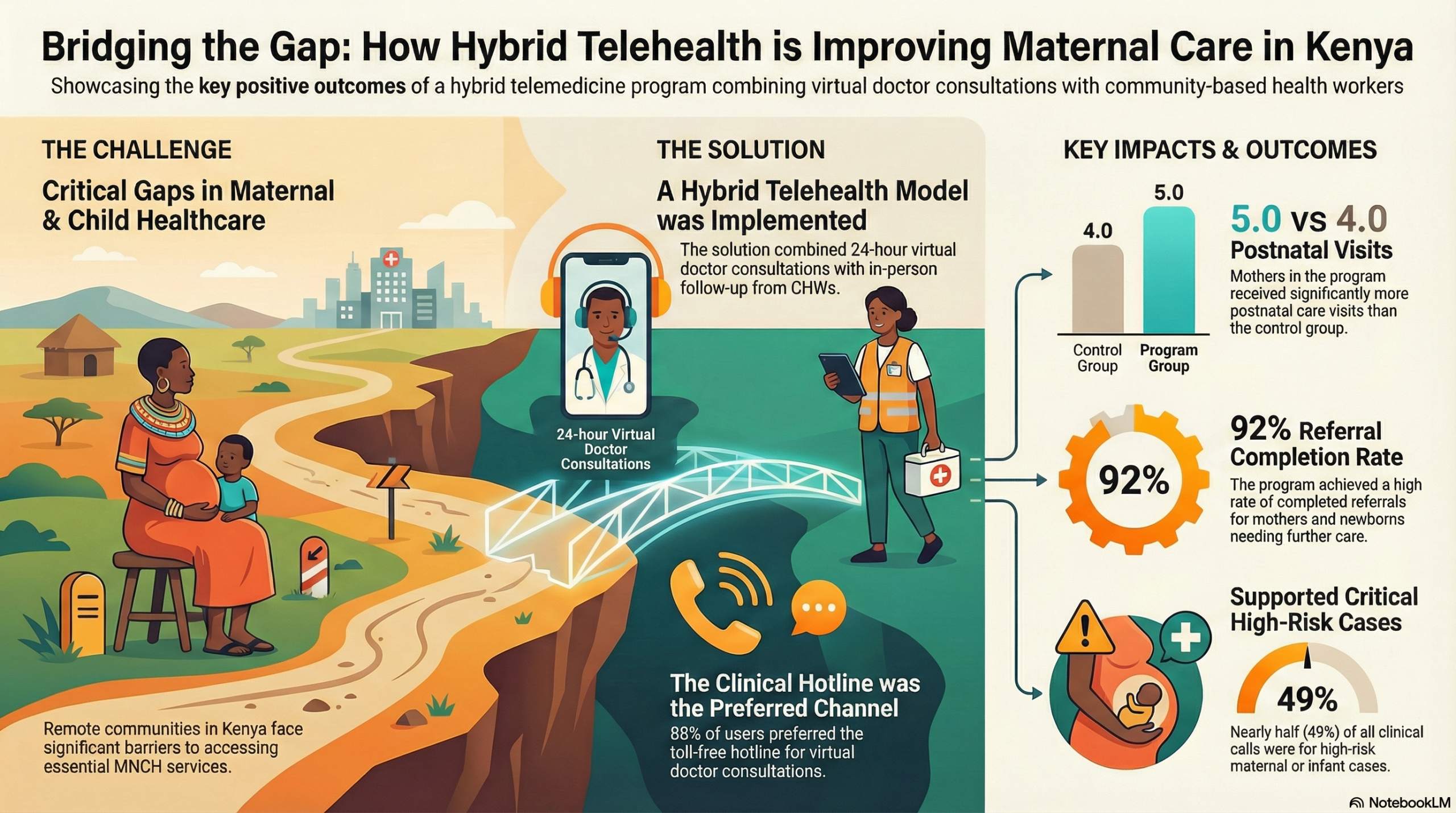
What the Evidence Shows (Kenya)
The study examines how community health promoters (CHPs), supported by real-time remote clinicians, manage maternal and child health cases in routine community settings.
Key Insights for System Design
- Quality at the Last Mile: Telemedicine improves clinical decision-making and guideline adherence by CHPs, closing the gap between community and facility care.
- Smarter Referrals: Faster, more accurate triage ensures families reach facilities when needed, while avoiding unnecessary visits.
- Trusted Community Care: Caregivers value knowing CHPs can consult clinicians instantly, strengthening confidence in public health services.
- Scalable by Design: When integrated with government protocols, digital platforms, and supervision structures, telemedicine becomes a system enabler, not a parallel solution.
Why This Matters
Kenya’s journey toward Universal Health Coverage depends on digitally enabled, clinically supported community health systems that governments can own, finance, and scale.
This research reinforces that telemedicine, when designed for integration, can increase the return on investment in community health and strengthen primary health care networks.
As we work alongside governments to mobilize sustainable financing and modernize community health delivery, evidence like this helps inform policy, digital architecture, and investment decisions for the next generation of health systems.
🔗 Read the full open-access article: https://www.frontiersin.org/journals/digital-health/articles/10.3389/fdgth.2025.1668776/full
Share:


