

Posted on: April 15, 2026
What Emerging Technology Needs to Succeed in Community-Based Primary Health Care—Not Just Through Pilots, but at National Scale
By Kanishka Katara, Living Goods Chief Digital Health Officer
Emerging technology like AI can expand the reach of healthcare, reduce costs, and improve health outcomes—but only if we design interventions with scale and affordability in mind from the start. That means building foundations that enable systems to perform at national level, not just in pilots.
In partnership with governments in Africa, Living Goods is driving the evolution from digital to intelligent health systems powered by AI that perform for people at scale, so that every family gets the care they need to live longer, healthier lives.
THE CHALLENGE
AI is the new buzzword in global health. I see it on conference agendas, in strategy decks—I’m almost seeing it in my dreams. But the future of global health will not be defined by how boldly we imagine AI. It will be defined by how responsibly and effectively we implement it.
Too many AI pilots in the health ecosystem sound exciting but are disconnected from reality. They are not designed with affordability, scalability, or integration within existing health systems in mind. Some are AI in name only. As a computer science engineer who in an alternative life would have been a medical doctor, I see both the opportunity and risk: we are underestimating the complexity of building technology that actually works to drive impact in health programs.

We must consider AI-interventions with the deepest sense of responsibility. Therefore, we need a more disciplined approach that prioritizes real problems, accounts for system constraints, and designs for scale and affordability from the outset. Otherwise, we will continue investing in pilots that never translate into impact at scale.
Finally, African governments have made huge strides in digitizing their health systems. But a hard question remains: are these just digital versions of old processes, or do they truly use intelligence—data, analytics, and smart workflows—to drive better health outcomes?
THE OPPORTUNITY
We now have a chance to build health systems, and the technology that powers them, differently designed for scale, grounded in real-world constraints, and focused on solving the hardest frontline problems.
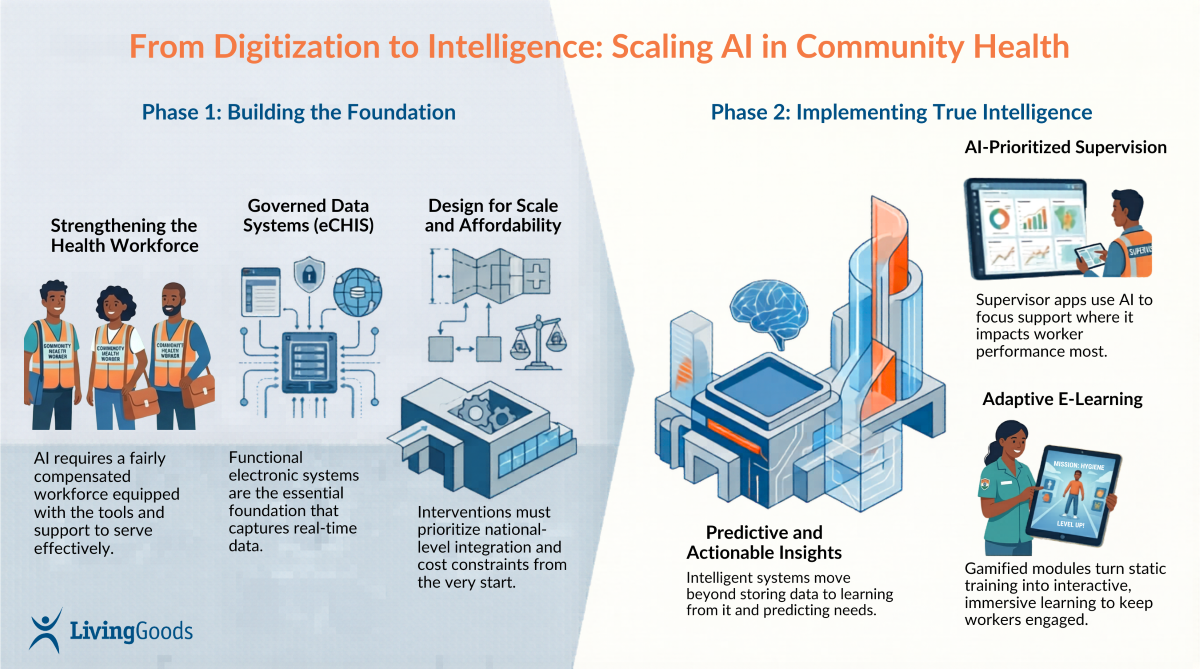
We must build the foundations for AI to work and invest in the infrastructure and people that allow it to endure. In primary health care, that means a well-supported community health workforce – fairly compensated, equipped with the tools and knowledge to serve, guided by supervisors who use data to continuously improve performance, and enabled by effective digital solutions. Also critical is a functional, well-governed electronic community health information system (eCHIS) – one that consistently captures the data and insights needed to guide decisions, improve performance, and respond to patient needs in real time.
You wouldn’t install a fancy hot tub on a crumbling building. In the same way, AI cannot succeed without strong underlying systems. This unglamorous “behind-the-scenes” work is often invisible and underfunded, but it’s what will allow AI to have the most meaningful impact.
The move from digitization to true intelligence is what will transform outcomes—technology that goes beyond storing data to learning from data. Intelligent systems can spot problems early, flag unusual patterns, predict what patients might need, and suggest what to do next. And intelligence should solve the problems that drive impact—reducing health worker workload, increasing efficiency, speeding up care, and lowering costs—so systems can deliver better outcomes with greater affordability.
LIVING GOODS’ APPROACH
In partnership with governments in Africa, Living Goods is leading the way in emerging technology like AI and building the foundational systems for it to perform at scale and at a cost governments can afford.
With nearly two decades of experience in community health and ten years in digital health, Living Goods is partnering with governments to build intelligent systems that turn data into actionable insights. These systems help predict behaviors, flag inequities in near real time, support better supervision, and equip frontline workers with adaptive decision-making tools to enhance performance. The result is care that is more targeted to where it is needed most, better aligned with patient needs, and delivered in a timely manner – ultimately saving more lives and building healthier communities.
Our supervisor app will be the first in the field to use AI to prioritize tasks, enabling supervisors to focus their support to community health workers (CHWs) where it can have the greatest effect on performance – and as a result health outcomes. And the e-learning platform we designed integrates AI-powered modules including gamification that turns static training into adaptive, interactive learning with immersive learning options to keep CHWs engaged and interested in pursuing learning.
OUR VISION
We partnered with African governments to make the transition from paper-based to digitised health systems. Now, we are working to make those systems intelligent. But intelligence alone is not enough. Systems must be owned by governments, designed for sustainability and real-world cost constraints, and solve the everyday challenges of CHWs.
Share:


