

Posted on: June 26, 2026
By Kanishka Katara, Chief Digital Health Officer at Living Goods
It was a hot and humid day in August 1995 when I learnt about one of the most fascinating and counterintuitive concepts in science: Latent Heat. Our Physics teacher, a well-meaning gentleman, started and ended his lecture with the same stern warning: “Listen to me carefully—don’t try this at home! Do you know what will burn you more severely: boiling water or steam, assuming both are at the same temperature and in the same quantity?”
Our intuitive and immediate guess was hot water at boiling point. To our astonishment, his answer was: “No. A steam burn is far worse than a splash of boiling water at the exact same temperature”.

I remember sitting in complete silence, trying to make sense of his statement. For the next few weeks, my fundamental understanding of science concepts was challenged to its very core, but Physics and Chemistry came to my aid. Our teacher explained it in a simpler manner: “The answer lies in the phase change itself. The heat is busy—invisible to the thermometer—breaking the polar covalent bonds that hold water together as a liquid so it can become vapor. To break these bonds, additional energy is needed. This hidden energy is what makes steam far more dangerous than boiling water.”
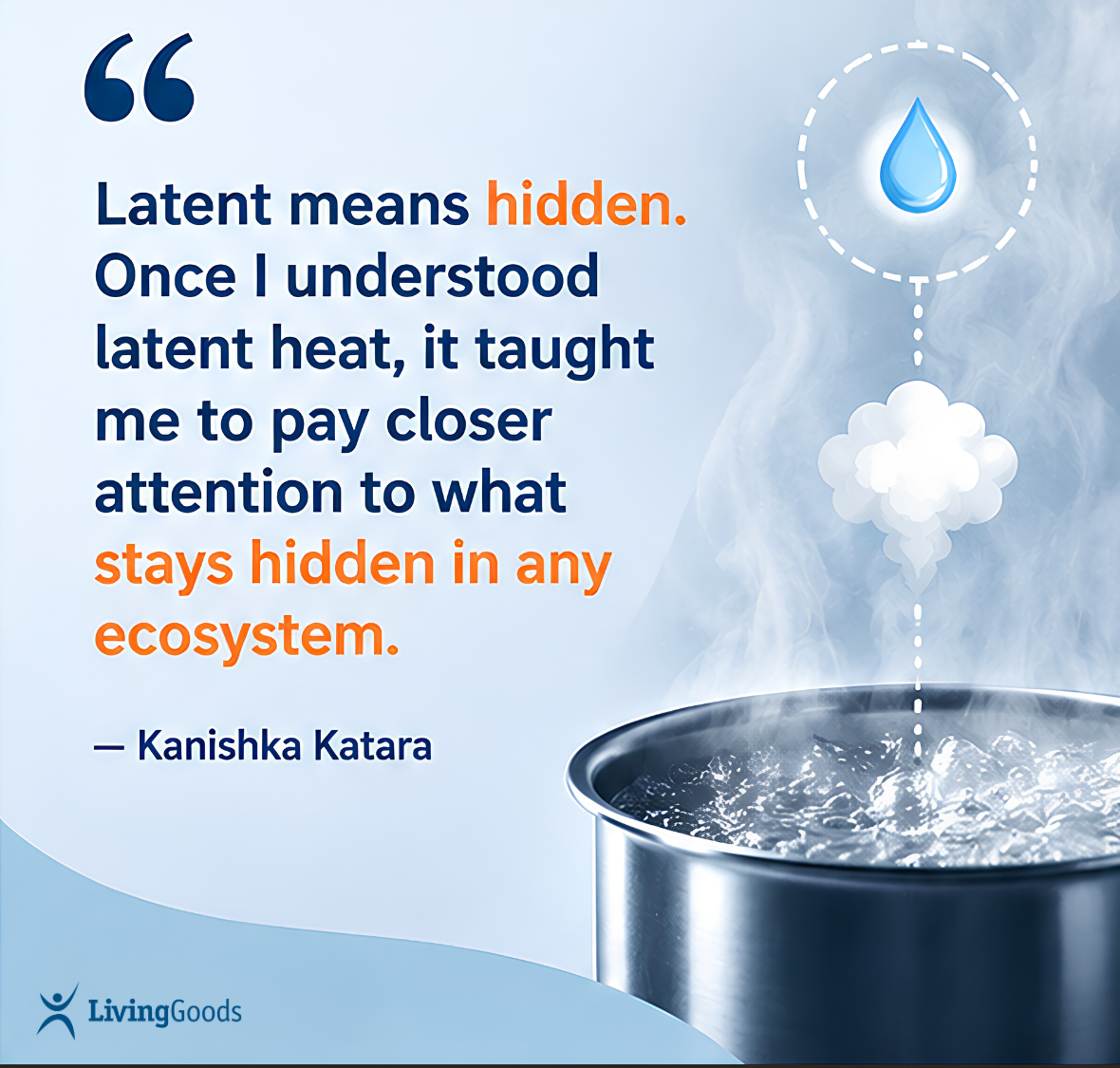
This is what physicists termed “Latent Heat.” Latent means Hidden in Latin. Once I understood this concept, it helped me realize the importance of paying more curious attention to what stays hidden or in other words, what stays latent in any ecosystem. This has stayed with me ever since. Fast forward 31 years to today!
What I have been doing over the past few years has nothing to do with Physics and yet I find the concept of Latent Heat becoming increasingly relevant to my field of practice—Digital Health. I have come to believe that our data systems have something very similar—and that most of us walk past it without noticing: Latent Data!
What I Mean by Latent Data
When we talk about data in community health, we usually mean the visible stuff: number of households visited, children screened for malnutrition, mothers counseled, treatments dispensed. These are the figures often on dashboards.
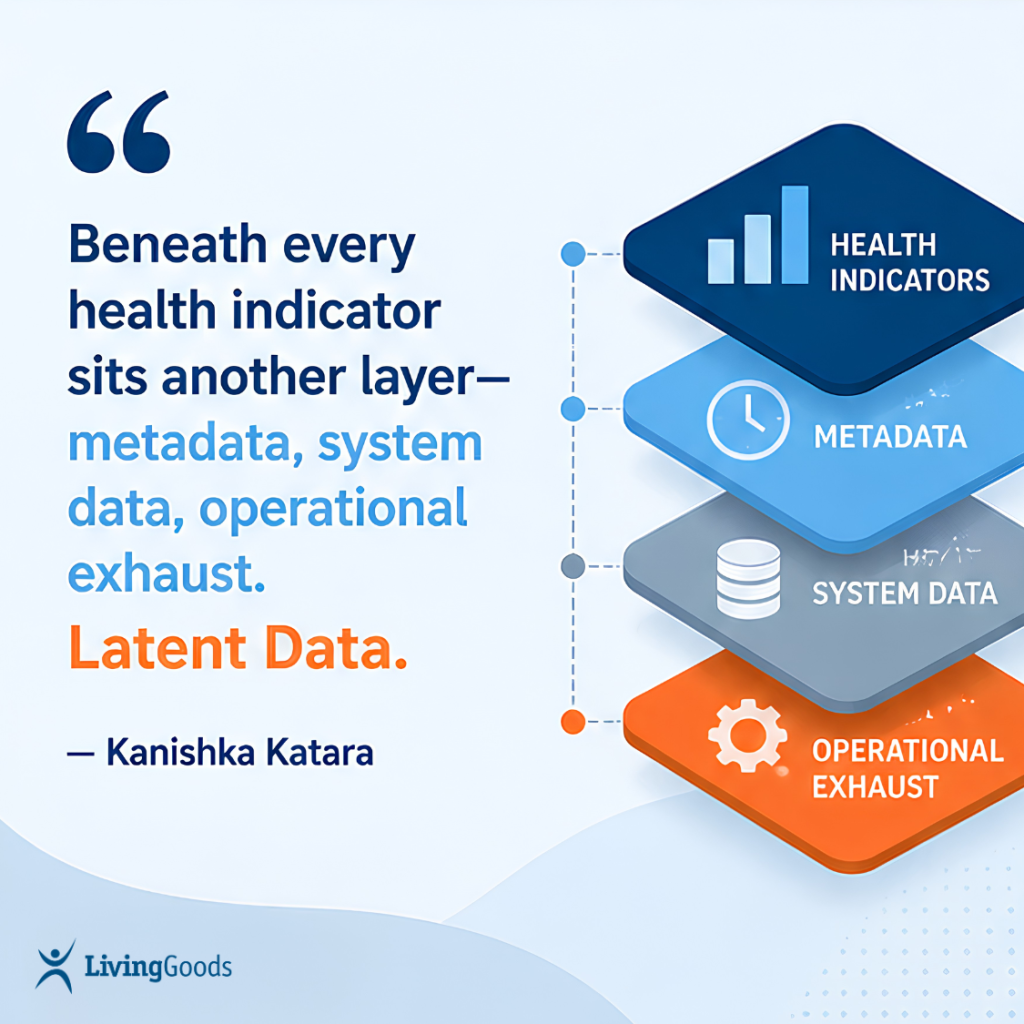
But beneath every one of these numbers sits another layer—metadata, system data, operational exhaust. Latent Data.
- When was that household visit logged? At the door, or three days later from memory?
- How long did it take the community health worker (CHW) to complete the digital form?
- Which version of the app was running? Did it sync? How many retries?
- Where exactly was the device when the record was created?
None of this shows up on the dashboard. But all of it determines whether the dashboard is telling the truth.
Why Latent Data Matters
Imagine a health provider who submits twenty household assessments in a day. The dashboard lights green. Targets met. Move on.
What if the latent layer reads like the following?
- 20 entries were submitted in a 15-minute burst.
- Average time-on-form was 47 seconds.
- The device’s GPS placed all twenty within a 30-metre radius.
- The data sat on the phone for eight days before syncing.
The headline number has not changed. But the meaning of that number has completely changed. Twenty visits, in the visible layer, becomes something quite different once the latent layer is read alongside it.
At Living Goods, we have observed that some of the most important program insights come not from the health records themselves but from the patterns surrounding them. Was a follow-up conducted on time, or days later? Did supervisors review and act on the case? How much time did a CHW spend counseling a mother? Are referrals moving smoothly through the system, or quietly stalling? Is a high-performing CHW delivering better care, or simply entering data faster? By analyzing patterns in supervision, follow up timeliness, referral completion, and data synchronization among others, we can identify bottlenecks earlier, target support where it is needed the most, and improve the quality and continuity of care before problems become visible in outcome indicators.

An example of a pattern we observed was inconsistent data syncs, even when the system uptime was high and network connectivity was stable. When we investigated this pattern using metadata, we realized that this was mostly due to the lack of background sync functionality of the technology stack. CHWs had to either keep their apps active or manually sync data whenever they had connectivity. As a follow up, we introduced refresher training for the CHWs to emphasize the need to manually sync data. Within a short period, data synchronization became significantly more consistent across the same group of users.
This is where Latent Data helps us to understand service delivery patterns and establish the causal relationship between the ‘how’ and ‘why’. Metadata answers the questions that primary data cannot:
- Was the workflow followed, or was it bypassed?
- Are we acting on fresh information, or on echoes from previous weeks?
- Where in the tool are users struggling, hesitating, or giving up?
- Is the pattern we’re seeing real, or is it an artefact of how the data was captured?
Without these answers, we are confidently reading thermometers where the water is at boiling point but there is no change in the thermometer reading. Latent data is what turns a number into a trustworthy number.
Key Takeaways: There are a few things I would recommend to anyone building or stewarding a digital health system:
- Treat metadata as a priority: It should be designed for, not accidental. If you only capture what you plan to report, you have built a system that cannot tell you when it is lying.
- Audit the invisible: Periodically pull timestamps, edit logs, sync records, and device data alongside your headline indicators. Ask whether the story they tell is the same story.
- Close the loop with frontline teams: Latent Data is at its most powerful when it flows back to CHWs and supervisors as feedback—not as surveillance, but as a mirror that helps them improve.
- Resist the dashboard reflex: Not everything worth knowing fits on a tile. The most useful insights often live in the joints between datasets, in patterns over time, and in what is missing.
The Messi Moment
There is a video of Lionel Messi where he moves through four, five, six defenders, and somehow the laws of physics seem to have politely stepped aside for him. He swirls and drifts, arriving at the goal as if he had been there all along and the defenders had simply forgotten. The heart is enthralled. It is mesmerizing in the way that only something working exactly as it was meant to can be.
As a practitioner of computer science, I feel a quieter version of that same enthrallment when data is used meaningfully. When a dashboard is not a wall of numbers but a window into a CHW’s morning, a household’s reality, a system humming the way it was designed to hum. When a decision lands not on a hunch or a headline, but on an honest reading of the evidence. That, to me, is when the work stops being technical and starts being human. That is when data stops being data and starts being change.
Over the years, I have seen stakeholders in governments, health programs, and funders begin to look beyond the visible layer of data and pay attention to the patterns beneath it. When Latent Data is brought into decision-making, the picture becomes clearer, leading to sharper and specific interventions, thereby making health outcomes more predictable and achievable.
That is the lesson. Messi does not defy physics. He understands it so completely that he makes the impossible look routine. The same is true of data. The power is not in the numbers we see, but in the hidden forces we learn to recognize.
Share:


